



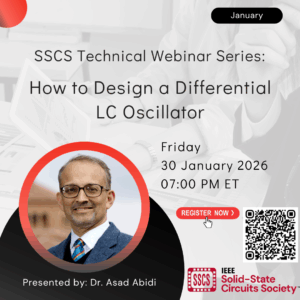
Abstract: This presentation will elaborate on some of the technical content of the paper of the same title published in the OJSSCS. The paper employs several methods that may be unfamiliar to readers. They are:
- How to separate PM from AM in a noise spectrum
- How to formulate approximate transfer functions for circuits subject to periodic large signal waveforms
- How to identify the most important sources of phase noise and mitigate the major contributors
- Why are second harmonic currents harmful
- How to choose between NMOS and CMOS differential oscillators
The presentation will conclude with a step-by-step design flow that invokes all the tradeoffs in an optimally designed differential LC oscillator.
Register: https://ieee.webex.com/weblink/register/r9877f7044f08be75c15a494bb0a594ac
Bio: Asad Abidi received the B.Sc. degree in Electrical Engineering from Imperial College, London, in 1976, and the Ph.D. from the University of California, Berkeley, in 1982. He worked at Bell Laboratories, Murray Hill, until 1985, and then joined the faculty of the University of California, Los Angeles, where he is Distinguished Professor of Electrical Engineering. With his students, he has developed many of the radio circuits and architectures that enable today’s mobile devices.
Professor Abidi has received the 2008 IEEE Donald O. Pederson Award in Solid-State Circuits and the 2012 and 2022 Best Paper Awards from the IEEE Journal of Solid-State Circuits. He was elected a Fellow of the IEEE in 1996, a Member of the US National Academy of Engineering in 2007, and a Fellow of TWAS, the World Academy of Sciences, in 2010.