



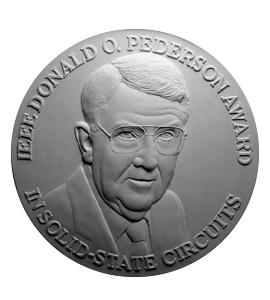
About the IEEE Donald O. Pederson Award
The IEEE annually recognizes outstanding contributors worldwide to the art and science of electro- and information technologies with technical awards in 3 dozen technical specialities.
The IEEE Donald O. Pederson Award for Solid-State Circuits for outstanding contributions in the field of solid-state circuits goes to an individual or team of not more than three. The award includes a bronze medal, certificate, and cash honorarium which are presented at the ISSCC.
The SSCS Awards Committee welcomes suggestions for nominations for any or all of these awards. Any person may nominate a candidate for an IEEE medal or award; self-nomination, however, is not allowed. The SSCS Awards Committee will help in the nomination process and will undertake finding appropriate nominators if necessary; the Committee can be contacted through the Chair.
The nomination process consists of the nomination itself and letters from 3 to 5 endorsers. Instructions for the nominator, guidelines and award criteria are available here.
The nomination forms can be filled in online or downloaded in a variety of word-processing formats. Please click here for more information.
Please send your recommendations to: Hideto Hidaka
It is acceptable to nominate an individual or team for more than one TFA for the same work (if the work falls within the scope of the respective TFAs). However, the nominee(s) cannot receive more than one TFA for the same work. A complete list of IEEE Technical Field Awards is available on the IEEE Web site: See the complete list of awards for links to the forms and the list of past recipients.
Wanda Kay Gass Receives 2027 IEEE Donald O. Pederson Award in Solid-State Circuits
Wanda Kay Gass is the recipient of the 2027 IEEE Donald O. Pederson Award in Solid-State Circuits for pioneering contributions to industry-leading programmable digital signal processing systems through circuit, architecture, and silicon compiler innovations.
Gass has made seminal contributions to single-chip Digital Signal Processor (DSP) architectures, sparking a technology revolution that enabled numerous products ranging from speech recognition-based products to digital cameras, set-top boxes, and cellular phones. These products have gone on to positively impact communication, entertainment, and education. Her co-invention of the TMS32010, and its integration in MOS technology, greatly reduced the need for analog signal processing, making it the first commercially successful DSP. This success rested on three key patents on which Gass is a co-inventor. Together, these innovations made it the first DSP that could be reprogrammed in any application without additional cost. As a result, it achieved an economy of scale: the same chip could satisfy diverse product requirements, and the combined volume across these products drove down the DSP’s price point. Over the following 30 years, Gass continued to build on this foundational architecture, refining both the underlying design and the chip design techniques to create a family of derivative DSP chips that enabled an even wider range of products. Remarkably, four decades after the original DSP was first commercialized, follow-on designs of this chip still fuel new emerging markets. Since retiring, Gass has dedicated herself to promoting K-12 STEM education for girls and mentoring women professionals in engineering, becoming a prominent source of inspiration for future generations of women scientists and engineers.
An IEEE Life Fellow, Gass is Texas Instruments Fellow (Retired), Dallas, Texas, USA.

Wanda Kay Gass
Texas Instruments Fellow (Retired),Dallas, Texas, USA
Past Recipients of the Donald O. Pederson Solid-State Circuits Award
Jan M. Rabaey
Professor Emeritus and Professor, Graduate School EECS Department, University of California at Berkeley, Berkeley, CA, USA
“For seminal and visionary contributions to the VLSI implementation of low-energy signal-processing and communication systems.”
Michiel S.J. Steyaert
Full Professor, Faculty of Engineering Science, KU Leuven, Leuven, Belgium
“For pioneering contributions to RF CMOS circuits and integrated power converters.”
Deong-Kyoon Jeong
Professor, Seoul National University, Seoul, Republic of Korea
“For leadership in the technology development for Digital Video Interface (DVI) and High-Definition Multimedia Interface (HDMI).”
Ingrid Verbauwhede
Professor, Research Group COSIC (Computer Security and Industrial Cryptography Group)
“For pioneering contributions to energy-efficient and high-performance secure integrated circuits and systems.”
Akira Matsuzawa
Professor Emeritus, Tokyo Institute of Technology, Tokyo, Japan and Founder & CEO, Tech Idea Co., Ltd., Kanagawa, Japan
“For pioneering contributions to low-power, analog-to-digital converters in systems on a chip (SoCs) for digital video applications.”
A. Paul Brokaw
Retired, Analog Devices Fellow
“For leadership in the design of voltage references, amplifiers, and power management, and for contributions to the principles of analog circuit design.”
Klaas Bult
Professor, Delft University of Technology – Fac. EEMCS, Delft, Zuid Holland, The Netherlands
“For leadership in embedded analog and mixed-signal integrated circuits.”
Laurence Nagel
President, Omega Enterprises Consulting, Kensington, California, USA
“For the development and demonstration of SPICE as a tool to design and optimize electronic circuits.”
William S. Carter & Stephen M. Trimberger
Fellows, Xilinx, San Jose, California, USA
“For contributions to field-programmable gate array technology.”
Takao Nishitani & John S. Thompson
Takao Nishitani (Representative Partner, Laisip, Kanagawa, Japan) & John S. Thompson (Consultant and President, Retired, Technology Pathways, Tucson, AZ, USA)
“For pioneering real-time programmable digital signal processor architectures.”
Miles A. Copeland
Distinguished Research Professor (Retired), Carleton University, Ottawa, Ontario, Canada
“For contributions to the design and application of switched-capacitor and RF signal processing circuits.”
Robert W. Adams
Fellow, Analog Devices, Inc., Acton, Massachusetts, USA
“For contributions to noise-shaping data converter circuits, digital signal processing, and log-domain analog filters.”
Past Recipients Solid-State Circuits Award
| Year | Recipients | Category |
|---|---|---|
| 2005 | Bruce A. Wooley, Professor, Stanford University, Stanford, CA, USA | “For pioneering contributions to integrated electronics for analog-to-digital data conversion in communications systems.” |
| 2005 | Eric Vittoz, Professor and Chief Scientist CSEMS.A.,Neuchatel, Switzerland | “For pioneering contributions to low-power device modeling and CMOS circuit design” |
| 2003 | Daniel Dobberpuhl, Vice President and General Manager Broadcom Corporation, San Jose, CA, USA | “For pioneering design of high-speed and low-power microprocessors.” |
| 2002 | Chenming Hu, University of California, Berkeley, CA, USA Ping Ko, Authosis, Inc., Quarry Bay, Hong Kong | “For contributions to MOSFET physics and development of the BSIM model for CMOS circuit simulation.” |
| 2001 | No Award | |
| 2000 | Robert H. Krambreck, Tandem Computers, Cupertino, CA, USA Stephen Law, Alaris, Inc., Fremont, CA, USA | “For pioneering the introduction and implementation of domino CMOS logic.” |
| 1999 | Kensall D. Wise, University of Michigan Ann Arbor, MI, USA | “For pioneering contributions to the development of solid-state sensors, circuits and integrated sensing systems.” |
| 1998 | Nicky Lu, Etron Technology Inc. Hsinchu, Taiwan | “For pioneering contributions to high speed dynamic memory design and cell technology.” |
| 1997 | Robert W. Brodersen, University of California, Berkeley, CA, USA | “For contributions to the design of integrated circuits for signal processing systems.” |
| 1996 | Rudy J. van de Plassche, Philips Research Labs Eindhoven, The Netherlands | “For pioneering contributions to the design of integrated circuits for data conversion.” |
| 1995 | Lewis M. Terman, IBM/T. J. Watson Research Center Yorktown Heights, NY, USA | “For leadership in the field of MOS devices and circuits for semiconductor memories.” |
| 1994 | Paul R. Gray, University of California Berkeley, CA, USA | “For contributions to analog integrated circuit design, especially for MOS switched capacitor circuits.” |
| 1993 | Kiyoo Itoh, Hitachi, Ltd. Tokyo Japan | “For technical contributions to folded data-line circuits and the development of high-density dynamic RAMs.” |
| 1992 | Barrie Gilbert, Analog Devices Beaverton, OR, USA | “For contributions to non-linear analog signal processing circuits.” |
| 1991 | Frank Wanlass, Standard Micro Sys. San Jose, CA, USA | “For the invention of Complementary MOS (CMOS) Logic Circuitry.” |
| 1990 | Toshi Masuhara, Hitachi, Ltd. Tokyo Japan | “For pioneering contributions to NMOS depletion-load circuits and the development of high speed CMOS memories.” |
| 1989 | James D. Meindl, Rensselaer Polytechnic Institute, Troy, NY, USA | “For contributions to solid-state circuits and solid-state circuit technology.” |
Past Recipients of the Solid-State Circuits Development Award
| Year | Recipient |
|---|---|
| 1988 | Karl Stein |
| 1987 | Robert Widlar |
| 1986 | Barrie Gilbert |
| 1985 | Donald O. Pederson |