




- This event has passed.
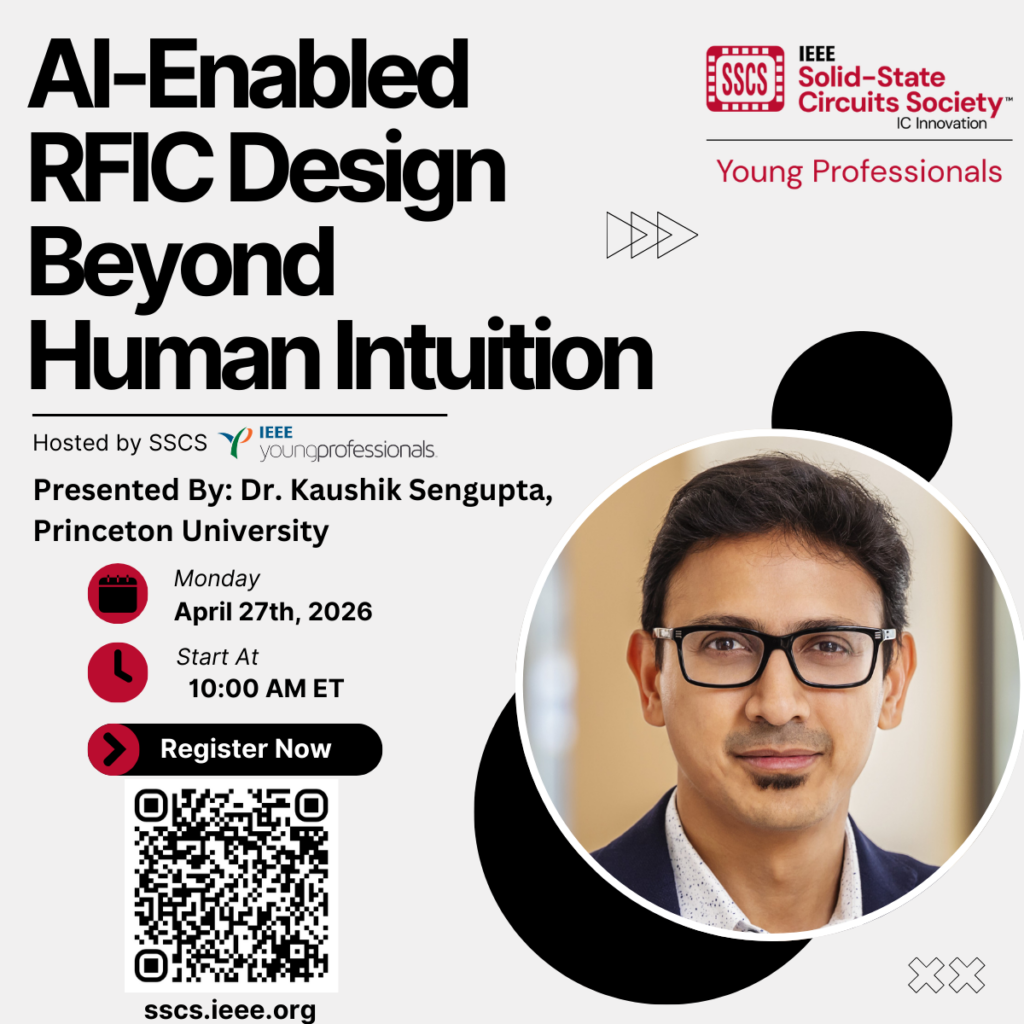

Abstract: Traditionally, chip-scale RF system design has been in the domain of the expert, dominated by thumb rules and trial-and-error techniques. Designing these ICs, which form the bedrock of wireless networks, is complex, time-consuming, requires years of expertise, and is therefore very expensive. Historically, the design process for RF ICs has relied on intuition-based approaches with standard templates that are subsequently optimized, time-consuming parameter sweeps, or ad hoc population-based metaheuristic optimization methods. There is no reason to believe that this approach is optimal in any sense. This talk will discuss how inverse design with AI-based approaches can open a new design space and enable rapid on-demand design. It will discuss deep-learning-based modeling and generative AI approaches that are transferable across process design technologies, for inverse design and automated synthesis of mmWave/sub-THz circuits and antennas.
Register now: https://ieee.webex.com/weblink/register/r2ed398e9053b2933e1173fd441de4fc7
Bio: Dr. Kaushik Sengupta is an IEEE Fellow and currently Professor in the Department of Electrical and Computer Engineering at Princeton University. He received a B.Tech/M.Tech (dual degree) in Electronics and Electrical Communication Eng. from the Indian Institute of Technology, Kharagpur, in 2007, an M.S. in Electrical Engineering from Caltech in 2008, and a Ph.D. in Electrical Engineering from Caltech in 2012. His research interests include novel chip-scale architectures for intelligent sensing and communication for a wide range of emerging applications. Dr. Sengupta is an IEEE Fellow. He received the DARPA Young Faculty Award in 2018, the Bell Labs Prize in 2017, the Young Investigator Program Award from the Office of Naval Research in 2017, the Prime Minister Gold Medal Award from IIT Kharagpur in 2007, the Charles Wilts Prize at Caltech for the best Electrical Engineering Ph.D. thesis in 2013, and the inaugural Young Alumni Achievement Award from IIT Kharagpur in 2018. He served as a Distinguished Lecturer for the IEEE Solid-State Circuits Society from 2019 to 2020 and for the IEEE Microwave Theory and Technology Society from 2021 to 2023. He is a recipient of the 2021 IEEE Microwave Theory and Technology Outstanding Young Engineer Award and the 2022 IEEE Solid-state Circuits New Frontier Award. He received the IEEE Microwave Prize in 2015, several best paper awards, including IEEE IMS (2020, 2021, 2022, 2025), RFIC (2012), and the Best Paper of the Year award from IEEE Journal on Solid-State Circuits in 2023 for the first deep-learning-enabled RFIC design.